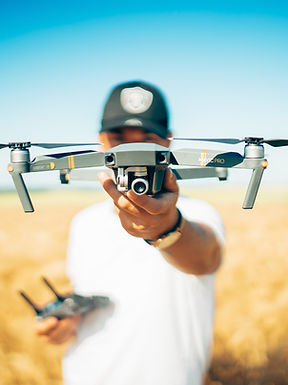
Drones and AI: When Autonomous Flight Meets Machine Intelligence
By Austin Lee
Drones have quickly changed from simple remote-controlled devices into important tools for science, business, and public safety. A major reason for this growth is artificial intelligence (AI). AI turns drones from “flying cameras” into smart machines that can notice what’s around them, understand what they detect, and react with less help from a human. In short, AI doesn’t just help drones fly—it helps them make decisions.
One of the most important AI abilities is perception, or “understanding the environment.” Modern drones collect information using cameras, GPS, inertial measurement units (IMUs), LiDAR, and other sensors. AI—especially computer vision—helps the drone make sense of that data. For example, an AI drone can detect obstacles, recognize objects, and track movement. That means it can spot a person during a rescue mission, follow a vehicle for traffic research, or notice damage on a bridge during an inspection. This is a big shift: drones are no longer just recording video—they’re analyzing it in real time.
Another key area is autonomy, which means a drone can fly and navigate more independently. AI can support mapping and navigation tools like SLAM, route planning, and obstacle avoidance. Instead of only following a pre-set GPS path, an AI drone can adjust when conditions change—like sudden wind, moving objects, or complex surroundings. This makes flights safer, mapping more accurate, and performance more reliable when people can’t control the drone every second.
AI-powered drones are especially useful in real life. In precision agriculture, drones can use special cameras to check crop health and help farmers focus water or pesticides where they’re needed most. In disaster response, drones can cover large areas and help teams locate survivors or hazards faster. In environmental research, drones can track wildlife, monitor coastlines, and spot invasive species, saving researchers a lot of time and effort.
Even with these benefits, there are still challenges. AI can make mistakes, especially in low light, fog, or unusual angles, which affects safety and reliability. Drones also raise privacy concerns because they can collect images in public spaces. And since AI learns from data, limited or biased training data can cause the drone to perform better in some situations than others. These concerns show why careful testing, responsible use, and clear rules are important.
Overall, drones and AI show a bigger trend in engineering: creating machines that don’t just move through the world, but can understand it. As AI becomes more efficient and drone technology improves, drones will likely become even more independent and more helpful in research, safety, healthcare delivery, and environmental monitoring. The future of drones isn’t only about better hardware—it’s about smarter intelligence in the sky.
​
​
TECH & TUNES SPECIAL
Can AI Really Make Music?
The new “band member” showing up in studios everywhere
By Austin Lee
​
​
​
​
​
​
​
​
​
​
​
​
​
​
​
​
If you’ve ever heard a catchy beat online and thought, “Who made this?”—here’s a surprising answer: sometimes it could be AI.
Artificial Intelligence is becoming a real tool in music. It can help create beats, suggest melodies, and even generate lyrics. But a bigger question is starting to pop up everywhere:
Is AI actually creative—or is it just copying what humans already made?
HOW AI MAKES MUSIC ?
AI learns music like this:
Listen (with data): It studies tons of songs.
Find patterns: It notices what notes, beats, and chords usually go together.
Generate ideas: It creates brand-new combinations based on what it learned.
Think of it like a student who has listened to thousands of songs and can now “suggest” what a new song might sound like.
QUOTE BOX
“AI can create sound, but humans create meaning.”
COLUMN: WHERE AI LOOKS MOST “CREATIVE”
AI is really good at speed and options. It can:
-produce lots of beat ideas in seconds
- remix melodies in different styles
- blend genres (like classical + hip-hop)
-create new sound effects and textures
For musicians, this is helpful because it’s like having a brainstorming partner that never runs out of ideas.
WHAT AI CAN’T DO (YET)
Even if AI makes something that sounds emotional, it doesn’t actually feel anything.
AI doesn’t have:
a favorite childhood song
a heartbreak story
nerves before a performance
a message it wants to share
That’s why human musicians still matter so much—because music is more than sound. It’s a story.
FUN FACTS
Did you know?
Some artists use AI to start a song, then rewrite it completely.
AI can help make music faster—but humans choose what feels “right.”
AI is often used like an instrument, not a replacement for artists.
AI can absolutely help make music—and it can sound impressive. But the best songs usually come from something AI doesn’t have: real human experience.
The future of music might not be “humans vs. AI.”
It might be humans + AI, creating new sounds together.
QUICK GLOSSARY
AI: a computer system that learns patterns
Melody: the main tune you hum
Beat: the rhythm you move to
​
​


Chief Editor's Message
Dear Reader,
Growing up, I was constantly inspired by the limitless possibilities of STEM. From new discoveries about the brain to rapid developments in artificial intelligence, I saw how science and technology shape the world around us—and how they continue to change what’s possible.
With the Mango Street Journal, my goal is to spark that same curiosity in young minds. I hope this journal encourages you to explore, question, and create—because discovering your passion early can be the first step toward making a real impact later.
​
Sincerely,
Chief Editor,
Austin Lee
​
Meet Us

Austin Lee
Chief Editor
I’m a senior at Issaquah High School, and as technology continues to evolve, so does my passion for STEM. I hope to share what I’ve learned and inspire younger students to stay curious, ask questions, and explore the endless possibilities STEM has to offer.

Hosannah Choi
Senior Editor
Welcome to the Mango Street Journal! I’m a freshman at Cornell University, and my passion for STEM keeps growing as technology advances. I hope this journal sparks curiosity and inspires younger students to explore, ask questions, and discover what’s possible.

Alvin Sung
Senior Editor
I am a sophomore in Carnegie Mellon University and will be majoring in AI.
I want to be part of The Mango Street because STEM has always been a passion of mine. I hope more people can understand the value of STEM by reading this research journal.
Ashley Sung
Senior Editor
I am a sophomore in University of Washington and will be majoring in nursing. I have been fascinated by science since I was a kid! I hope to share my passion to more people through this journal and my artwork.
Hadassah Choi
Founder
I am a junior at Harvard.
I have always been interested in biology, especially genealogy and cells. I hope to dive deeper into these topics and share what I learn. In the process, I also hope to help others find their passion for STEM.
.jpg)


